64 docs indexed
Multi-tenancy
How obleth models tenants, API keys, fairshare groups, and quotas, and how they relate to each other.
obleth's identity model has four layers: fairshare groups, tenants, API keys, and quotas. Understanding how they fit together helps you design the right configuration for your use case.
The Tenants page lists every tenant alongside its fairshare weight, token budget, and concurrency cap, so you can see your whole tenancy at a glance:
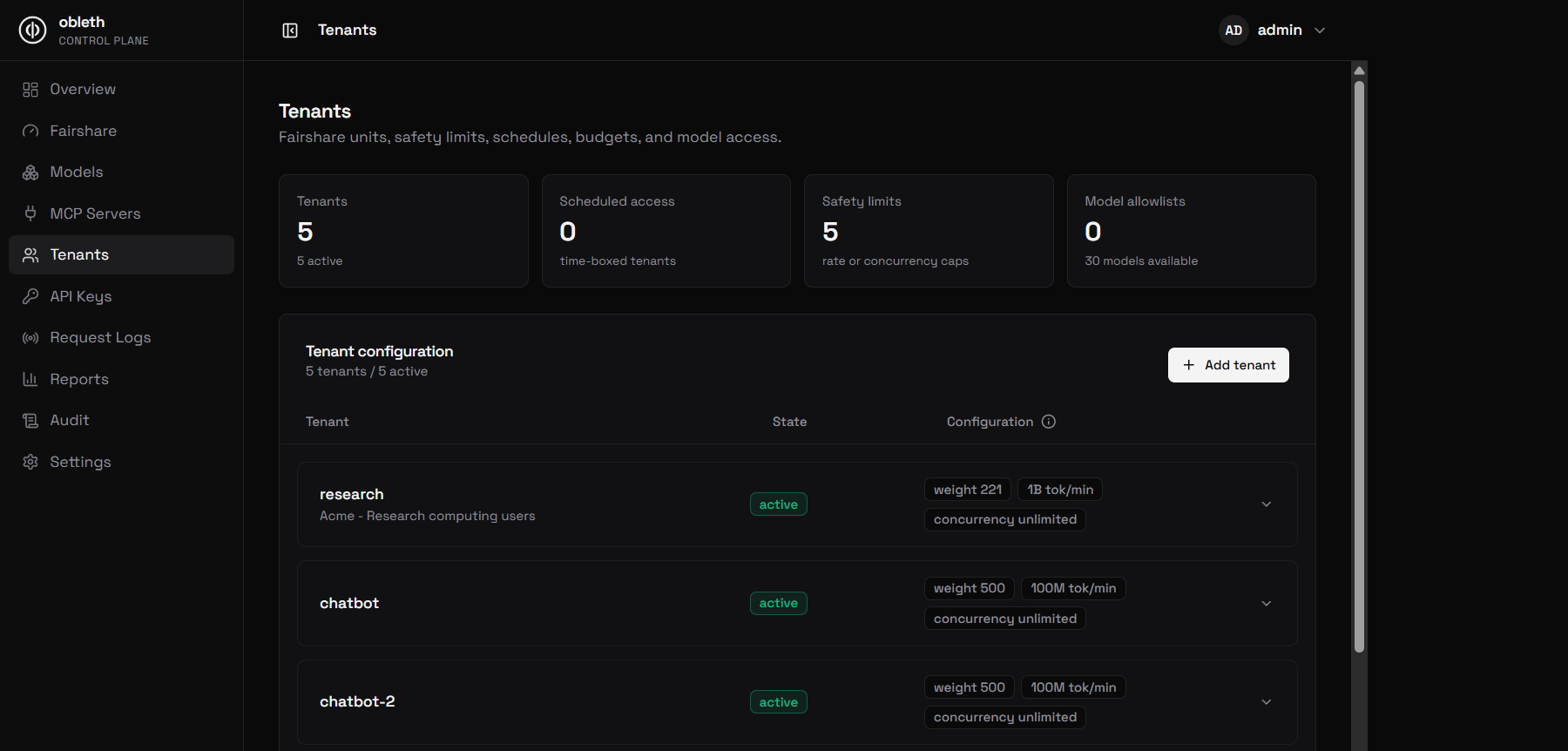
Tenants
A tenant is the unit of fairshare. Every API key belongs to exactly one tenant, and fairshare weight is applied at the tenant level.
{
  "id": "550e8400-e29b-41d4-a716-446655440000",
  "name": "chatbot",
  "fairshare_group": "prod",
  "weight": 500,
  "tokens_per_minute": 2000000,
  "max_in_flight": null
}
| Field | Purpose |
|---|---|
name | Human-readable identifier. Unique. |
weight | Fairshare priority. Higher = larger share under contention. Min 1. Default 100. |
tokens_per_minute | Sustained token budget (rate limit). The token bucket refills at this rate. |
max_in_flight | Optional per-tenant concurrency cap. null means only the global limit applies. |
fairshare_group | The fairshare group this tenant belongs to (defaults to "default"). |
Create a tenant:
curl -X POST http://localhost:9180/api/v1/tenants \
  -H "Authorization: Bearer $TOKEN" \
  -H "Content-Type: application/json" \
  -d '{
    "name": "chatbot",
    "weight": 500,
    "tokens_per_minute": 2000000
  }'
API keys
API keys are the authentication credential clients use on the data plane. Each key belongs to one tenant.
{
  "id": "...",
  "tenant_id": "550e8400-...",
  "name": "prod",
  "key_prefix": "sk_a1b2c3d4e5f6a1b",
  "disabled": false,
  "created_at": "2026-01-15T10:00:00Z"
}
The raw secret (e.g. sk_a1b2c3d4...48hexchars) is returned once at creation and never stored. Only a SHA-256 hash is kept. If you lose the secret, rotate the key (delete and create a new one).
A tenant can have many keys (e.g. one per environment: prod, staging, ci). All keys for the same tenant share the same weight and quota.
Create a key:
curl -X POST http://localhost:9180/api/v1/tenants/$TID/keys \
  -H "Authorization: Bearer $TOKEN" \
  -H "Content-Type: application/json" \
  -d '{"name": "prod"}'
# Returns: {"key": {...}, "secret": "sk_..."}
Disable a key (useful for rotation without deleting):
curl -X PUT http://localhost:9180/api/v1/keys/$KEY_ID/disabled \
  -H "Authorization: Bearer $TOKEN" \
  -H "Content-Type: application/json" \
  -d '{"disabled": true}'
Fairshare groups
Groups are optional. Every tenant is in the "default" group unless you create and assign one.
Groups are only meaningful under the hierarchical fairshare algorithm. Under weighted, groups are ignored and all tenants compete globally.
Create a group:
curl -X POST http://localhost:9180/api/v1/fairshare/groups \
  -H "Authorization: Bearer $TOKEN" \
  -H "Content-Type: application/json" \
  -d '{"name": "prod", "weight": 500}'
Assign a tenant to a group:
curl -X PATCH http://localhost:9180/api/v1/tenants/$TID/group \
  -H "Authorization: Bearer $TOKEN" \
  -H "Content-Type: application/json" \
  -d '{"fairshare_group": "prod"}'
Under hierarchical, the prod group (weight 500) will receive a proportionally larger slice of global capacity than the default group (weight 100), regardless of how many tenants are in each.
Quotas
Quotas operate at the tenant level and are enforced per-pod via Redis token buckets:
tokens_per_minute: the token-bucket refill rate. A tenant withtokens_per_minute=60000can sustain 1000 tokens/second. The burst ceiling equals the same value.max_in_flight: an optional hard cap on concurrent requests for this tenant. If set, a tenant can never hold more than this many permits simultaneously, regardless of the global limit.
Update quota:
curl -X PUT http://localhost:9180/api/v1/tenants/$TID/quota \
  -H "Authorization: Bearer $TOKEN" \
  -H "Content-Type: application/json" \
  -d '{"tokens_per_minute": 4000000, "max_in_flight": 20}'
All quota changes propagate to Redis and are picked up on the next request.
Lifecycle and access windows
Beyond quotas, a tenant carries lifecycle and scheduling controls that decide whether it may send traffic at a given moment:
| Field | Purpose |
|---|---|
status | active admits traffic; suspended and archived reject every request with 403. |
timezone | IANA timezone the windows below are evaluated in (default UTC). |
active_from / active_until | Optional activation and expiry timestamps. Outside this range the tenant admits no traffic. |
weekly_windows | Optional recurring windows: {day: 0-6 (0=Sunday), start_min, end_min} in minutes from local midnight. When set, traffic is only admitted inside a window. |
These are useful for time-boxed access (a trial tenant that expires), or off-peak
batch tenants that should only run on weeknights. See the
Management API
for the status, schedule, and budget routes.
A tenant can also carry a cumulative term budget (token and/or USD caps over a
lifetime, monthly, or term period) and a model allowlist. Both are
covered in Quotas & Rate Limits.
Two optional per-tenant content policies round out tenant configuration: a guardrails policy (scan and block/redact/log request and response content) and a compression policy (per-piece control over input-token reduction). Both are set per tenant and left unset by default.
The resolved key
On the data plane, everything reduces to a ResolvedKey — the compact hot-path representation cached in moka and Redis:
{
  "key_id": "...",
  "tenant_id": "...",
  "tenant_name": "chatbot",
  "fairshare_group": "prod",
  "group_weight": 500,
  "weight": 500,
  "tokens_per_minute": 2000000,
  "max_in_flight": null,
  "disabled": false
}
This is the only thing the data plane reads. It carries everything fairshare admission needs — no relational lookup on the hot path.